

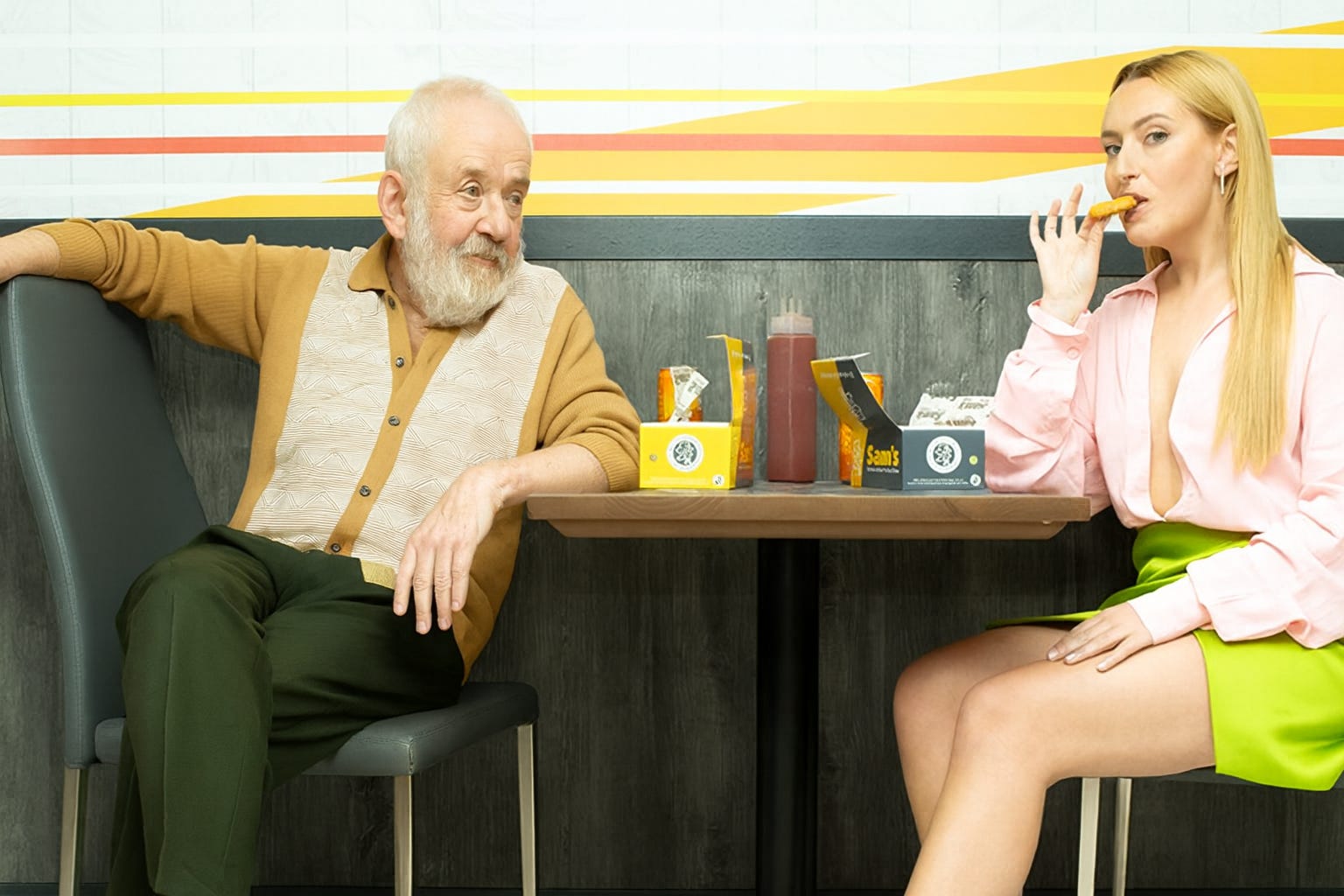
I’ve been reading this huge book of Mike Leigh interviews recently. I’ve been trying to reconnect with the sort of serious films I would watch when I was younger. And there’s something about watching a Mike Leigh film which is a film made with absolute intention that hits differently.
Leigh’s films are famous for the improvisations that lead to the creation of characters and plot lines. Projects starting with an inkling of an idea but financiers having to commit the budget before a word is written or a storyline full formed. This got me thinking about the effort of creation we invest in our day to day work.
How much of our commercial creativity could benefit from the slow careful assemblage of lives that characterises Leigh’s approach?
LEIGH’S REHEARSAL ROOM
When Leigh starts a film he might have a topic or theme he wants to explore. Often these are driven by the ‘state of the nation’.
ABIGAIL’S PARTY was a biting satire of class in the 80s.
It’s hard to watch NAKED now - 30 years later- and not see the start of the current masculinity issues the world is struggling with.
Once he has an inkling he assembles actors. There is always something he has inside him he wants to say about the world, even if he doesn’t know exactly how to say it.
He doesn’t tell the actors how big or small a role they will have. He asks them to find a person in their real life, someone they’ve met, and play at being a character based on them for a period of the rehearsal process.
As his process has developed he has moved beyond one ‘person’ to taking characteristics from two or three different people.
The actors then improvise key moments in this character’s life. From childhood through to death. An emphasis is placed on the relationships that form and fall. Different actors from the troupe rotated in and out of scenes.
A whole life is imagined.
And actors are compartmentalised. They don’t know what the other actors are up to at all times. They only know the scenes they are in.
Famously this culminated in the cast of VERA DRAKE only realising what the film was about when the police knocked on the door to arrest her. (This was in an all day improvisation, not for the first time during filming.)
But what this allows Leigh and his collaborators to do is explore. To find truth through playing.
There is no set script or end point. The film or theatre piece has no shape until they find it.
The actors bring themselves to the script. They’re not ‘inventing’ emotions to hit pre-scripted highs and lows. They are looking at the world and reflecting it back through themselves. The improvisations - preparing a meal together, eating it, washing up - are simple and mundane.
Making time for real life lets real experiences into the project.
KEEP IT SMALL
Leigh is not a ‘big Hollywood’ filmmaker, though his films have found success he operates on a small budget - rehearsal is a cheap way for him to build without the crew and pressure of a film set. But other directors have taken this experimentation and brought it on to the set.
I remember reading that Terence Malick has started to increasingly shun large crews on the day of shooting. His crew (unless a big scene/set up) is supposedly just the DOP (Chivo), a camera assistant, hair & make up, soundie, and a script supervisor. An art department has already built and dressed the sets. He predominantly shoots with natural light so there is no need for all the trucks and electricians normally required. His handheld stream of consciousness shooting style requires no heavy grip equipment.
Everyday when Malick walks on to set he lets his own intuition and the light guide them into what they are shooting that day.
He lets the relationships of the actors play out in front of the lens. Simple situations captured like poetry.
Maybe this is a reaction against some of his earlier movies (THIN RED LINE, etc) requiring such a mammoth production - but this cut down approach gives him more time to experiment, more speed to move with the whim of discovery.
He can respond in real time to how he and his actors feel.
He can find truth rather than sticking to a script.
Kubrick in EYES WIDE SHUT (with the exception of crowd scenes) would often have the sets pre-lit, predominantly with practical lighting (lamps, Christmas lights), and then clear the majority of the crew out whilst he actually shot.
The bedroom scenes were captured with a simple small crew. So that every day (and there were many days) that they shot each scene the budget did not balloon.
Now Kubrick was famous for doing an incredible number of takes, but what was he looking for? Life. Real life.
Kubrick shot so much material because he wanted the actors to get tired. He wanted them to drop their guards, their ‘performances’. He thought that breaking them down in this way took them to a place of honesty. Their own frustrations and tiredness revealing a part of them that he could not get in the early takes whilst they were still fresh.
Time and effort revealed truth.
For these masters time became a gift more than any large crew of experts could.
MAKE THE SHORT
I always get disappointed when on LinkedIn or in my inbox I see a new ‘short’ from an up and coming director and it doesn’t live up to what it could be.
The directors celebrate the fact that they could make their vision free from the trappings of client’s feedback and requests. And it’s clear to see these shorts have been agonised over for months.
But these shorts all have one thing in common. They are only shot in a day or a weekend. They are only possible because of the favours amazing technicians have gifted (in the hope of more paid work).
You can see how the perfect lighting has eaten up most of the shooting time. The extended tracking shot the rest.
The actors (even if paid and good) are forced to deliver 8 pages of dialogue and action across all the set ups the Director and DOP have prepared. There’s little room for experimentation, little time to uncover unexpected truth.
Why are we doing this to ourselves?
Are we creative or stylists?
Instead of writing scripts that require everyone I’ve ever met on a professional set to give up their weekends to create beauty, I’d be crafting something that requires less production. Something that requires less precision. Something that gives time for exploration and truth.
I also wouldn’t be making a short, praying that someone else gives me the money to make the film I actually want to make, I’d be making a YouTube series.
Like the black box theatre as opposed to the Broadway spectacle, I’d be doing something that has lower production expectations from its audience. Not lower expectations just less reliance on polish.
Something that can grow and evolve and learn from the audience in real time.
Not a one and done and disappear but something that reiterates and evolves.
NUGGETS
Amelia Dimeldonberg is celebrating ten years of CHICKEN SHOP DATES. Something that started out as a column in a student magazine has grown into an IP behemoth.
Recently she has created an exhibition that reflects on her journey and hosted a series of livestreams on YouTube that discuss content creation in the age of YouTube.
She spoke about the lo-fi production nature of Chicken Shop dates
She spoke about how much of the footage they shoot is left on the cutting room floor.
She spoke about how the more she did it the better she got at doing it.
But imagine if the pressure had been higher. Imagine if the cost of production required so much investment or so many different people to fall into place that when she was starting out it was harder to pull it together?
Imagine if every episode had to have a full grade and sound mix on an off day from a post-house?
Imagine if everything had to be ‘perfect’?
Because as I realised from listening to the various creators on Amelia’s panels - It’s not about perfection it’s about persistence.
The more you do something the more it shows the audience that you are committed to that thing. The more you are committed to that thing the more people who appreciate what you are doing will come back.
If you just do one and done - people won’t see the commitment. You won’t build an audience. And whether you’re a storyteller, a comedian, a journalist, or an advertiser - isn’t an audience the most important thing?
What is ‘cinema’ without an audience?
EFFORT IS YOUR CURRENCY
If everyone can make everything using Sora then how do you stand out? With effort.
In an age of automation the more we explore and play and go beyond ‘perfection’ the more we bring our own value to the table.
If you’re sitting there with a script you haven’t touched in months, or an idea that keeps feeling too ambitious to start. If you’re watching more YouTube how-tos rather than getting started or spending more time trying to co-ordinate other’s calendars to help you - stop waiting, start doing.
What’s something you can create that doesn’t require lots of other people to commit?
What’s something that gives you time to experiment and explore and find your own humanity?
Not a big idea but an exploratory process?
What if instead of making ‘one thing’ you gave yourself a runway to connecting with an audience that developed over time?
What if you didn’t start with a vision of the finished product but let the act of creation and the audience shape it into what it wanted to be?
What would your creative work look like if you gave it more time to find itself?
"Not a big idea but an exploratory process" (!!!) This is such a better way to think about the act of creation, especially for online content. Loved this one :)